


































- Date de naissance : 23 mars 1912
- Lieu de naissance Wyrzysk (Poland)
- Date de décès : 16 juin 1977
- Lieu de décès Alexandria (United States)
- Nationalité :
 Germany
 - Personne
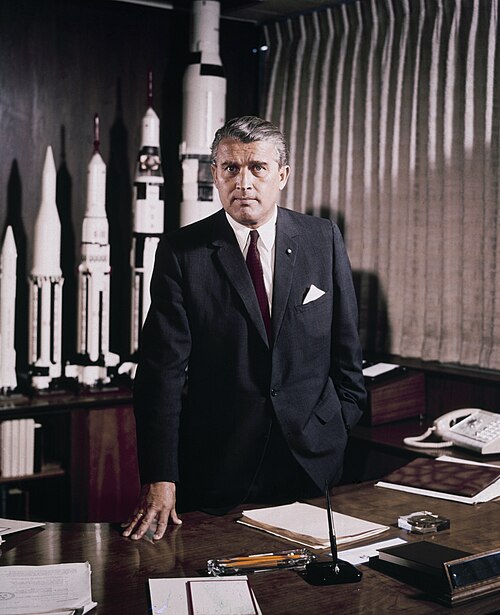
Wernher Magnus Maximilian Freiherr von Braun (US: /ˈvɜːrnər vɒn ˈbraʊn/ VUR-nər von BROWN; German: [ˈvɛʁnheːɐ̯ fɔn ˈbʁaʊn]; 23 March 1912 – 16 June 1977) was a German American aerospace engineer and space architect. He led the development of German rocket technology in World War II, during which time he became a member of the Nazi Party and later the Allgemeine SS. Following the war, he relocated to the United States, developing missiles for the US Army and later designing rockets for NASA’s Apollo program.
As a young man, von Braun worked in Nazi Germany's rocket development program. He helped design and co-developed the V-2 rocket at Peenemünde Army Research Center during World War II. The V-2 became the first artificial object to travel into space by crossing the Kármán line on 20 June 1944. Following the war, he was secretly moved to the United States, along with about 1,600 other German scientists, engineers, and technicians, as part of Operation Paperclip. He worked for the United States Army on an intermediate-range ballistic missile program, and he developed the rockets that launched the United States' first space satellite Explorer 1 in 1958. He worked with Walt Disney on a series of films, which popularized the idea of human space travel in the US and beyond from 1955 to 1957.
In 1960, his group was assimilated into NASA, where he served as director of the newly formed Marshall Space Flight Center and as the chief architect of the Saturn V super heavy-lift launch vehicle that propelled the Apollo spacecraft to the Moon. In 1967, von Braun was inducted into the National Academy of Engineering, and in 1975, he received the National Medal of Science.
Von Braun is seen by some as escaping justice for his participation in Nazi war crimes due to the Americans' desire to beat the Soviets in the Cold War. He is also sometimes described as the "father of space travel", the "father of rocket science", or the "father of the American lunar program". Towards the end of his career, he also advocated a human mission to Mars.
Numéros d'identification
- IMDb ID (nm0902042)
- MusicBrainz artist ID (d3534e6d-e651-4e39-918e-6fc7941c8a1f)
- ISNI (000000012132837X)
- VIAF ID (51769292)