 Washington State - A Ouija board helps solve a theft case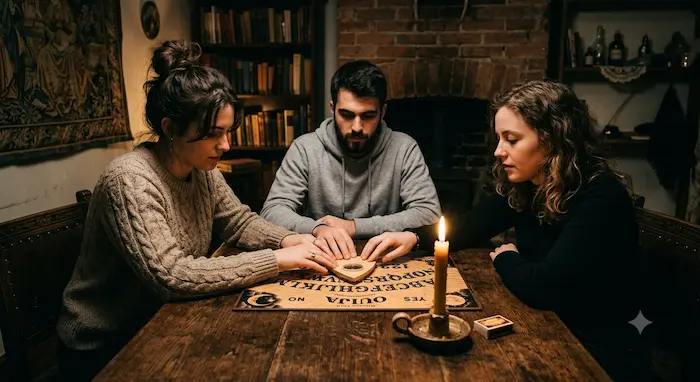
Some objects, it is said, bring misfortune to whoever handles them carelessly. The Ouija board, that old companion of séances popularized in the late 19th century, has just offered fresh proof of this — not in a haunted parlor or a lonely cemetery, but in the decidedly prosaic offices of the Moses Lake Police Department in Washington State. Last Friday afternoon, a resident in the 1100 block of East Nelson Road reported that their vehicle had been broken into while they were away. The stereo had been torn from the dashboard, house keys and several prescription medications were missing — and along with them, a Ouija board.
It was this last, seemingly trivial detail that would ultimately seal the suspect's fate.
Chance, an officer's memory, and a traveling board
Earlier that same day, Officer Isaac Taylor of the Moses Lake Police Department had had a routine encounter with a woman carrying a Ouija board in a bag — an object unusual enough to stick in a patrolling officer's memory. When the burglary report came in a few hours later, mentioning a Ouija board among the stolen items, Officer Taylor recalled the earlier encounter. He located the woman, later identified as 36-year-old Tasha Marie Wehrli, near Pioneer Way and Riviera Avenue.
A search confirmed the suspicion: not only was the Ouija board still in her possession, but so were the other items reported stolen from the vehicle. According to the police department's statement, Wehrli then allegedly attempted to flee before being subdued and arrested without further incident.
A heavy charge sheet
Tasha Marie Wehrli was booked into Grant County Jail on multiple counts: second-degree vehicle prowling, third-degree theft, possession of a legend drug (a prescription medication held without a valid prescription), third-degree malicious mischief, and resisting arrest. Under Washington State law, second-degree vehicle prowling is classified as a gross misdemeanor, carrying a maximum penalty of up to a year in jail; the statute does not even require that anything actually be taken from the vehicle for the offense to be established — mere intent to commit a crime inside is sufficient.
The Ouija board, an object steeped in history — and superstition
Far from being a mere flea-market curiosity, the Ouija board belongs to a long American tradition of supposed communication with the beyond. First marketed in 1890 under the name "Ouija," then popularized in the following decades by manufacturer William Fuld, it became the very symbol of the domestic séance, at a time when the Spiritualist movement — born from the Fox sisters' phenomenon at Hydesville in 1848 — was enjoying considerable popularity across the United States. Used both as a family parlor game and as a serious divination tool, the board has carried a troubled reputation through the 20th and 21st centuries: some see it as a simple parlor game driven by the ideomotor effect — the unconscious muscular movement that, according to many psychologists, accounts for the planchette's motion without any supernatural intervention — while others continue to view it as a doorway, sometimes a dangerous one, onto the unseen.
Whether one leans toward the rational explanation or the paranormal thesis, the Moses Lake episode feeds a particular strand of folklore: that of stolen objects which, one way or another, end up turning against their thief.
Superstitions of the criminal underworld
There is a persistent idea in American popular culture that criminals form a particularly superstitious lot — an observation owed, among other things, to the mythology of Gotham City's masked vigilante, but one that also finds a more serious echo among criminologists studying the rituals and beliefs peculiar to criminal circles. In publishing the details of the arrest on social media, the Moses Lake Police Department did not fail to note the irony of the situation: an object traditionally meant to reveal hidden truths ended up, in this case, playing a very concrete role in revealing a suspect's identity.
"Many say that criminals are a superstitious lot. In this case, it would seem that the old adage held true in the most literal way possible."
What the official statement says
The passage below faithfully reproduces, in translation, the account released by the Moses Lake Police Department regarding the circumstances of the arrest:
"On Friday afternoon, officers responded to a report of a vehicle prowl in the 1100 block of East Nelson Road. The stereo had been ripped from the dashboard; house keys and several prescription medications had been taken, along with a Ouija board. Earlier that day, Officer Isaac Taylor had contacted a woman, later identified as Tasha Marie Wehrli, who was carrying a Ouija board in a bag. Remembering the encounter, he relocated Wehrli near Pioneer Way and Riviera Avenue. A search recovered the board along with the other items reported stolen. Wehrli was booked into Grant County Jail on charges of second-degree vehicle prowling, third-degree theft, possession of a legend drug, third-degree malicious mischief, and resisting arrest."
Spiritism - 26/07/2026 - Wakonda - 


Publicité

