


| Localisation | Bountiful (United States) |
| Date de l'événement | 21 septembre 1997 |
It begins as an ordinary drive. Jeff Olsen is heading home to Bountiful, Utah, after visiting family in the southern part of the state. Beside him, his wife Tamara has dozed off. In the back seat, their seven-year-old son Spencer plays quietly while their toddler, Griffin, sleeps in his car seat. The road stretches on, night falls, and Jeff feels his eyelids grow heavy.
What he later describes as "a blink that lasted a second" is enough to upend four lives. The car leaves the road and rolls over several times in a crash of shattering glass and flying gravel. When it finally comes to rest, Jeff regains consciousness for a moment, overwhelmed by pain, hearing Spencer crying before blacking out again.
The outcome will be devastating: Tamara and young Griffin do not survive the crash. Jeff himself is found in critical condition — his legs crushed, his abdomen torn open, his right arm nearly severed. According to the account he gave years later, it is at this exact moment that his story shifts from a roadside tragedy into something he still cannot fully explain.
"I was hovering above the wreck"
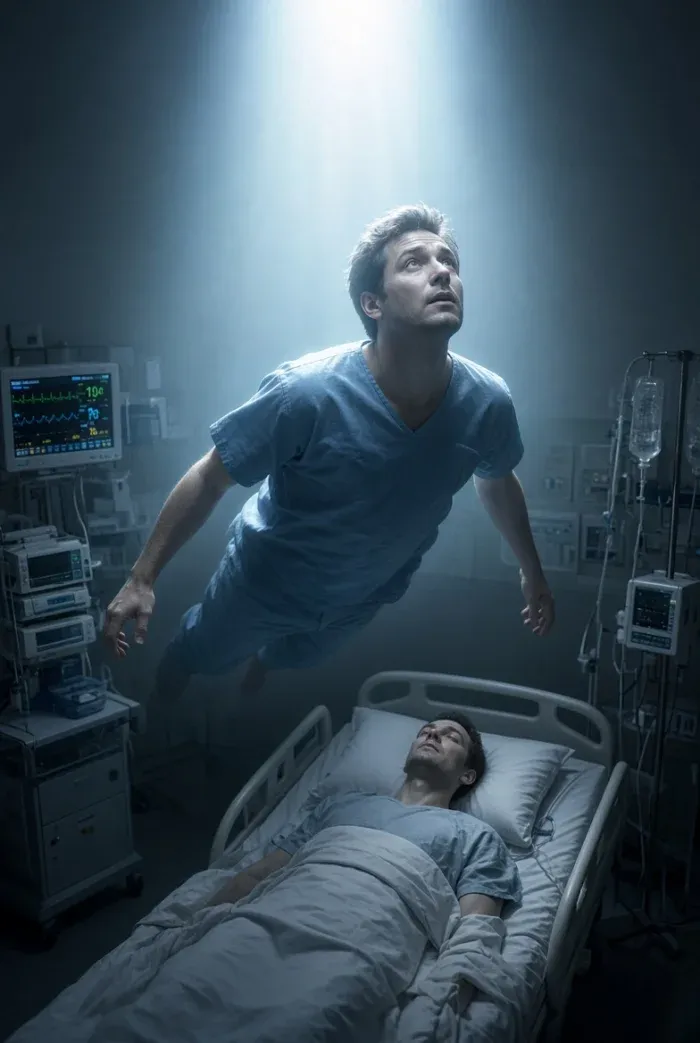
Jeff Olsen says he left his body at the very moment of impact. Free of pain, in a state of total calm, he says he found himself floating above the wreckage, where a familiar presence joined him: Tamara, enveloped with him in what he describes as "a bubble of light" radiating complete peace.
According to his account, his wife then spoke to him in no uncertain terms: he could not stay, he had to go back. Spencer, still alive, needed him. Jeff says he said goodbye to Tamara before feeling himself "drift" away from her — only to find himself, moments later by his account, floating through the halls of the hospital he had just been rushed to, watching the patients and staff around him without pain or judgment, before recognizing, in horror, his own unrecognizable body on a gurney.
"Tamara looked at me, her face serious. 'Jeff, you cannot be here,' she said. 'You have to go back.'"
Across the corridor, a doctor who "sees" too
This is where the story takes a rare turn for this kind of account: there is a second witness, and that witness is an emergency room doctor. Dr. Jeff O'Driscoll had just finished his rounds when a nurse, Rachel — with whom he had spent months quietly confiding experiences neither of them dared mention to colleagues — pulled him aside: "Come see this. His wife is... here."
Dr. O'Driscoll says he had already lived through episodes he himself calls irrational, even before entering medicine — including a premonition at sixteen that he believes spared him from a worse car accident, and later, as a physician, a hunch that led him to order a CT scan that turned out to be lifesaving for a patient with no apparent symptoms. That day, in the room where staff were working to stabilize Jeff Olsen, he says he sensed a presence, then made out, floating above the bed, the translucent figure of a woman with curly blonde hair, dressed in white, her face serene — a figure he "knew," without being told, to be the patient's wife.
According to his account, the figure gave him a look filled with gratitude toward the medical team before fading away. Nurse Rachel, present at the same moment, immediately turned to him and asked: "Did you see her too?"
The meeting at the hospital
A few weeks later, according to both men's accounts, Dr. O'Driscoll visited Jeff Olsen's bedside — by then in rehabilitation following the amputation of a leg — to tell him, with nurse Rachel's help, what they believed they had witnessed. Jeff Olsen reportedly replied that the description matched Tamara exactly, before sharing in turn his own experience from the day of the crash. The two men now point to this moment as the start of a friendship that has lasted more than twenty years.
A phenomenon far from isolated
The Olsen/O'Driscoll case belongs to a much broader body of near-death experience (NDE) testimony, reported by patients and, more rarely, by the medical staff around them. Among the most cited documented cases is that of Don Piper, declared clinically dead after a car accident in Texas in 1989, and that of surgeon Mary Neal, herself a physician, who nearly drowned in an accident in Chile in 1999.
Psychiatrist Bruce Greyson, professor emeritus at the University of Virginia and author of a rating scale still used today to assess the depth of these experiences, has catalogued thousands of accounts since the 1970s that share striking common features: leaving the body, a tunnel, light, a feeling of peace, encounters with deceased loved ones, and a "chosen" or forced return to the physical body.
What science says: the residual-consciousness hypothesis
On the clinical side, the researcher who has pushed this debate furthest is arguably Dr. Sam Parnia, a pulmonologist and resuscitation specialist now at New York University. Between 2008 and 2012, his AWARE study, conducted across several hospitals in the United Kingdom, the United States and Austria on more than 2,000 cardiac arrest patients, sought to objectively test out-of-body reports — notably by hiding objects on high shelves in resuscitation rooms — without any patient managing to identify them convincingly.
A follow-up study, AWARE-II, published in 2023 in the journalResuscitation, instead detected, in some cardiac arrest patients, electrical brain signatures — delta, theta, alpha and beta waves, normally associated with higher states of consciousness — up to an hour after resuscitation began, even though the brain was presumed starved of oxygen. For Dr. Parnia, this data suggests that"consciousness may separate from the brain at the point of death,"a hypothesis that nonetheless remains a minority view and is fiercely debated within the scientific community.
The critical view: the neurological hypothesis
Against these interpretations, several neurologists offer strictly physiological explanations. Dr. Kevin Nelson, of the University of Kentucky, showed in a study published in the journalNeurologythat 60% of people who had experienced an NDE had a history of "REM intrusion" — a state in which dream mechanisms bleed into wakefulness — compared with only 24% in a control group. According to him, the brainstem of certain individuals may simply be more prone to blending sleep and wakefulness under extreme stress, producing luminous visions and a sense of bodily dissociation with no supernatural explanation required.
Other researchers also point to an acid-base imbalance caused by excess carbon dioxide in the blood (hypercapnia), which can trigger hallucinations and out-of-body sensations. Still, these neurological models currently struggle to account for one specific aspect of the Olsen/O'Driscoll case: the overlap between the vision reported by the patient and the independent, unprompted one reported by a member of staff present in the room — a detail that, if accurate, falls outside purely intracranial explanations, since it involves two distinct nervous systems at the same moment.
A case that remains open
Neither a proven miracle nor a fully explained hallucination: the testimony of Jeff Olsen and Dr. Jeff O'Driscoll illustrates the current limits of science when faced with experiences lived at the edge of clinical death. Twenty years after the crash, the two men say they have remained close, and credit this improbable meeting with part of their recovery — Jeff Olsen having notably gone through a deep depression before finding, he says, meaning in what he had lived through.
Absent any protocol capable of objectively verifying a perception shared by two separate people at the critical moment, this kind of testimony will most likely remain, for a long time to come, a matter of personal account rather than scientific proof.
Sources
 - Voir l'historique


Publicité