 Ballinspittle, 1985: The Day a Concrete Virgin Began to Move
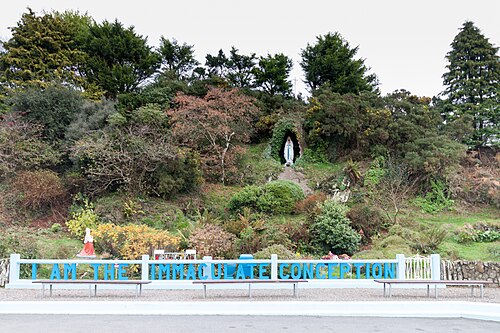
Statues of the Virgin Mary said to possess strange properties are not in short supply around the world. Most of them stop at weeping, sometimes bleeding. One in a small village in County Cork, Ireland, went much further during the summer of 1985: it was said to move on its own. Forty years on, the phenomenon still divides believers, psychologists and historians.
A Village of 200 Souls, a Grotto and Eleven Light Bulbs
Ballinspittle then had about 200 inhabitants, between the seaside town of Kinsale and Garretstown. On a hillside, a grotto housed a statue erected for the Marian Year, lit by a halo of eleven electric lamps. The whole structure dated from 1954, and the statue itself was made of concrete. Its maker later recalled that the hands had been reinforced with wire. Nothing about this ordinary object of devotion hinted at an international destiny.
Late July 1985: The First Accounts
Accounts differ as to who the first witnesses were. The Irish Times reports that two women out for a walk near the grotto saw the statue move. An encyclopedia of the paranormal speaks instead of two teenage girls. A local resident, Catherine O'Mahony, says for her part that children claimed to have seen the statue move after the recitation of the rosary. These versions are not necessarily contradictory, but they show how quickly, and through how many voices, the legend took shape.
What followed is better documented. The next evening, forty villagers came to check for themselves, and all of them said they had seen the statue move. Soon almost the entire village claimed to have witnessed the marvel.
The Rush: Tens of Thousands of Pilgrims
The rumor spread at remarkable speed. The following Tuesday, a thousand visitors arrived. By the end of the first week, the railway company CIE was running special services, eighty volunteer stewards were managing the site, and attendance averaged 10,000 people a night. A report by Irish television broadcaster RTÉ, aired on 31 July, described some 8,000 people gathered, a round-the-clock vigil and a local committee set up to handle the influx.
On 15 August, the Feast of the Assumption, thousands of the faithful crowded in front of the grotto. In all, as many as 100,000 people are said to have descended on the village between late July and August. American, British and Australian media relayed the story.
The Epidemic of Moving Statues
Ballinspittle did not remain an isolated case. Similar phenomena were reported almost immediately in Dunmanway and Courtmacsherry. The first claims of this kind had appeared in Asdee, in County Kerry, and in Ballinspittle. By the end of the summer, Marian apparitions were being reported from Sligo to Kerry, and as far as Kilkenny and Waterford. In September, a Sunday newspaper even published a map of Ireland marking 28 sites. 1985 went down in Irish memory as "the year of the moving statues."
Some pilgrims also reported healings. On 31 July, a Cork woman who had been deaf since the age of twenty claimed to have regained her hearing during a visit to the grotto.
The Church Keeps Its Distance
The Catholic hierarchy reacted with great caution. Bishop Michael Murphy of Cork and Ross called for "common sense" and announced that he would not visit the grotto, for fear that his visit would be taken as an endorsement. He nonetheless admitted that he welcomed the sight of crowds gathering in a great spirit of fervor. One bishop eventually described the whole affair as a mere illusion. Years later, a resident claimed that the local clergy had always preferred to look the other way.
Psychologists Offer Their Explanation
The Department of Applied Psychology at University College Cork investigated. Its researchers concluded that it was an optical illusion, which they dubbed the "Ballinspittle Phenomenon." Their main argument concerned light: the statue only seemed to move as night fell. They also pointed out that people sway slightly when standing still for a long time, which makes the object they are staring at seem to move. The team recorded 31 apparition sites across the country.
Psychologist Peter Davison argued, in an RTÉ report, that the shimmering of the statues was due to the autokinetic effect. This well-known phenomenon makes a stationary point of light appear to move when viewed in darkness. Other hypotheses circulated at the time, including mass hypnosis among people ready to see the statue move, or a poor tourist season fueling the movement. A more recent observer has placed the episode in an Ireland whose historic bond with the Catholic Church was beginning to change.
What the Witnesses Say
Believers are not convinced. A witness quoted by the Irish Examiner says that in July 1985 she saw the concrete statue float in mid-air. Another replies that light could not explain why the face changes appearance. Catherine O'Mahony, now a member of the grotto committee, saw the statue move six weeks after her first sighting, then several more times, most recently in August of the year she gave her account. She says she still receives letters from people asking her to pray for them at the grotto.
A Site Still Alive
The phenomenon faded fairly quickly, but a few small circles of devotees persisted for several years. The statue was even vandalized: attackers armed with hammers damaged it, and it was then repaired. Pilgrims have continued to gather there since it was put back in place. The upkeep of the grotto relies on a committee and a genuine community effort.
Collective illusion or miracle? The two readings have lived side by side since 1985, and neither has managed to erase the other. The optical explanation is solid and widely accepted, but it has never extinguished the conviction of those who say they saw the Virgin move. At Ballinspittle, the question remains open for the witnesses themselves.
Marian apparition - 21/11/2026 - Wakonda - 


