 Croglin Grange: The Cumbrian Vampire, Between Family Legend and Victorian Fiction
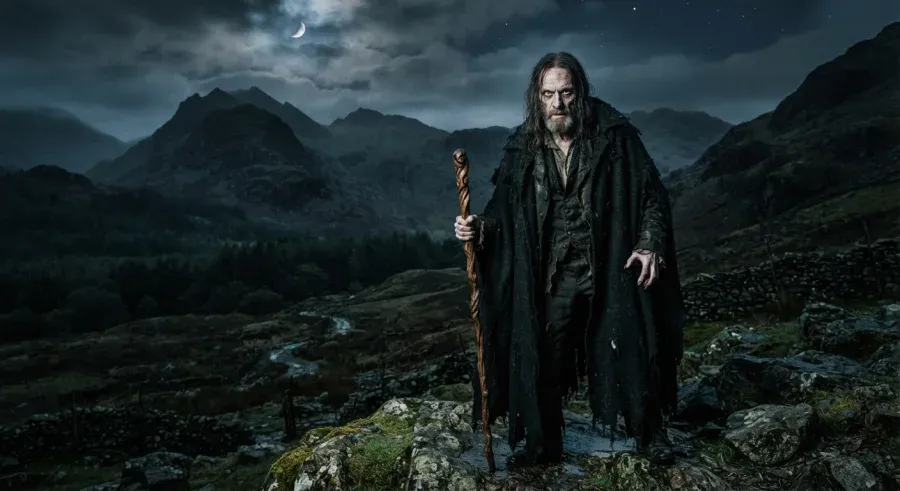
A forced window, a bite on the neck, a ransacked vault: the tale of the "Croglin vampire" is the most famous in England. But does its house exist, and its church?
A Lost Village at the Edge of Cumberland
Croglin is a tiny hamlet in the former county of Cumberland, now part of Cumbria in north-west England. Nothing destined it for posterity. Yet its name appears in every anthology of British supernatural lore, thanks to a story that fits in a few pages: that of a young woman attacked in her bedroom, on two summer nights a year apart, by a creature that tradition eventually labelled a "vampire".
The tale has remained attached to a dwelling, Croglin Grange, which is today identified with Croglin Low Hall, an isolated farm less than three kilometres from the village. Legend has it that the events date back to the period following the English Civil War, in the 1650s. The Fisher family, owners of the place, are said to have passed the story down from generation to generation, until one of their descendants told it to a man of letters in 1896.
Augustus Hare and Captain Fisher
That man of letters was Augustus Hare (1834-1903). A travel writer, biographer and sought-after raconteur of Victorian high society, he devoted six volumes to his own life, published in two waves between 1896 and 1900 under the title The Story of My Life. In it he reports, in all seriousness, a tale heard from a certain Captain Fisher, identified by other sources as Edward Fisher-Rowe.
Hare places the conversation at a dinner in 1874. His companion, having just listened to him reel off one ghost story after another, replied that his own family possessed an even stranger one. The Fishers, he said, had for centuries occupied an old estate in Cumberland called Croglin Grange. Having outgrown it, the family had moved to the south of England, near Guildford, and let the property to tenants.
What the Account Says
According to Hare, the new occupants were siblings: a sister, Amelia, and her two brothers, of the Cranswell family. The house was single-storey, its bedrooms looked onto a lawn, and beyond it lay a graveyard. On a stifling summer evening, the windows were left open. Amelia, unable to sleep, saw two points of light advancing through the night. They were the eyes of a figure with a brown, shrivelled, mummified-looking face. The creature popped out a pane of glass by working at the lead, climbed into the room and bit the young woman on the neck. Her screams alerted her brothers, and the attacker fled.
The victim recovered, travelled, then returned the following year. The attack was repeated. This time the brothers were armed. One of them fired and hit the assailant in the leg. The creature made for the graveyard and vanished into a vault. The next day the villagers watched the crypt being opened: the coffins were smashed and their contents scattered, except for one, whose lid was merely lifted. Inside lay a desiccated, intact body bearing the gunshot wound. The body was burned, and the vampire was never heard of again.
A House That Does Not Exist… Or Almost
This is where the investigation begins. From the early twentieth century, the curious went to the spot and found no house called Croglin Grange. The author Charles G. Harper, in Haunted Houses (1907), noted the absence of that name, but found two neighbouring buildings, Croglin High Hall and Croglin Low Hall. The occultist Montague Summers, a staunch defender of the story, argued that Low Hall matched the description and that Hare may have recorded the name wrongly.
Later research partly reinforces this hypothesis. Property deeds indicate that, until 1720, Croglin Low Hall was sometimes called Croglin Grange. In 1963, the journalist F. Clive-Ross discovered that the story was known to the entire village. The tenant of the property even showed him the window through which the vampire was said to have entered, and descendants of the Fishers were still living in the area. In 2005, Richard Whittington-Egan unearthed the rental records: the Fisher family took the lease on Low Hall in 1809.
The Missing Graveyard
The most awkward point remains: no church or vault exists today near Low Hall. Yet a map by Robert Morden dated 1695 shows "Crogling Parva" at that location with, right beside it, a "Crogling Church". According to tradition, this building was destroyed during the Wars of the Three Kingdoms (1638-1651), which would fit a legend born in the 1650s. The church's presence on a 1695 map, however, casts doubt on that chronology. Its stones are said to have been reused in other buildings, and almost nothing of it remains.
The Sceptical Analysis: A Tale With No Echo Before 1874
Sceptics raise several objections. First, the story left no written trace before the 1874 conversation. Researcher Geoff Holder, who devoted a chapter of Paranormal Cumbria (2012) to it, combed the works of Cumbrian folklore published between 1874 and 1900 without finding the slightest mention. For an episode as spectacular as a vampire burned in front of an entire village, this silence seems weighty, especially as the event should logically have left a mark in the local press.
Second, vampirism has little place in traditional English folklore. The Croglin story predates the publication of Dracula (1897) by more than twenty years, which its defenders cite as an argument for its priority, but several commentators see similarities with Varney the Vampire, a hit serial of the 1840s whose nocturnal intrusion scene strongly recalls the one at Croglin.
Third lead: the mischievous captain. The British magazine The Skeptic has suggested that Fisher was no liar, but a man with a robust sense of humour, who served a credulous storyteller a tale invented for the occasion. Brian Dunning, of the Skeptoid podcast, goes further: he sees a fabricated or embellished story, of which Hare would be the source, and which the twentieth-century Fishers eventually came to believe was a long-standing tradition. He admits nonetheless that an intruder could have entered a tenant's bedroom one evening without that making a vampire.
What Can Be Said With Certainty
The solid facts are thin. A Captain Fisher did tell this story to Hare in 1874. A house called Croglin Low Hall exists, which was called Croglin Grange before 1720, and the Fisher family was its tenant. A neighbouring church did exist, then disappeared. As for the attacks, the vault and the burned body, nothing attests to them outside Hare's account. The file thus oscillates between genuine local tradition and Victorian fiction skilfully rooted in a real place. It is precisely this mixture that explains its longevity: enough truth to unsettle, enough vagueness to resist any verification.
Cryptozoology - 28/11/2026 - Wakonda - 


Publicité

