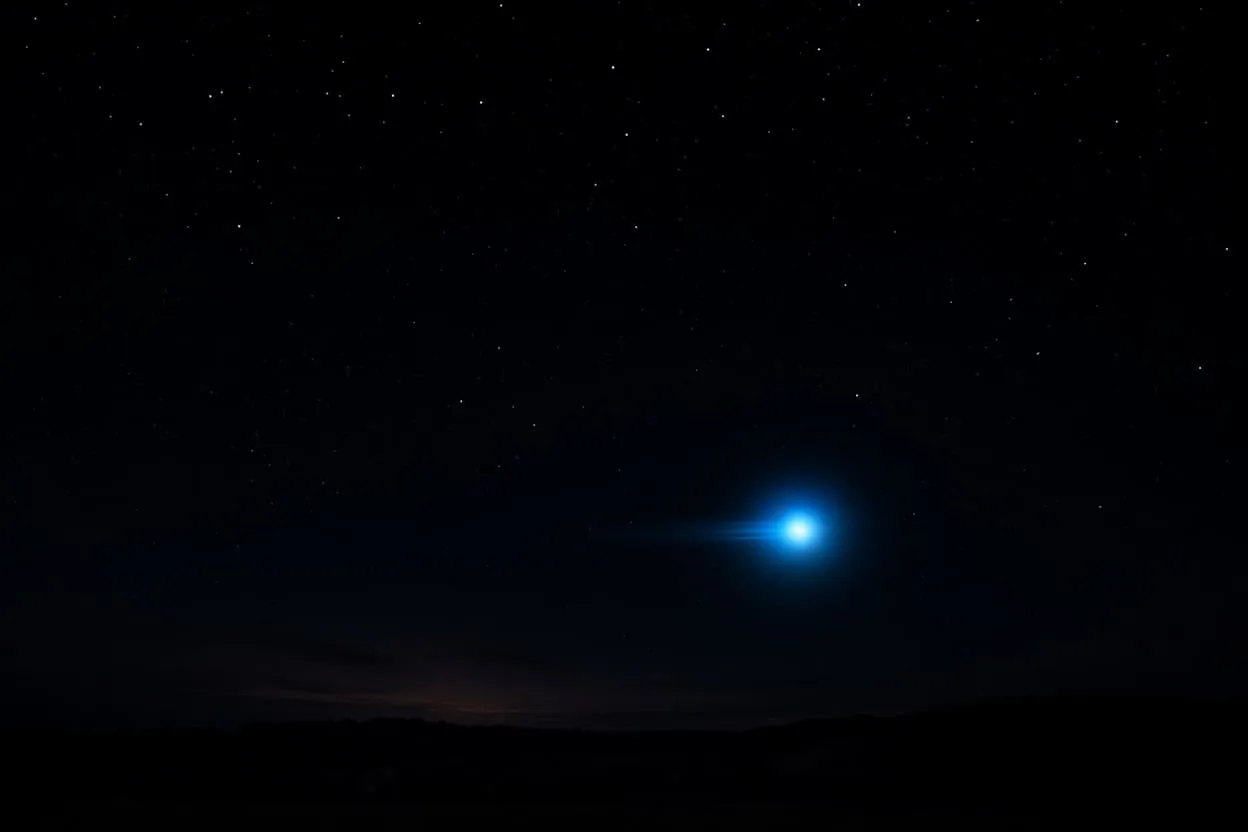





























It was a short, dry dispatch carried by the United Press wire out of New York that threw the small town of Jamaica, on Long Island, into a state of excitement in the closing days of December 1907. According to the account later published by thePueblo Sunof Colorado, a large balloon had appeared over the town, low and visible enough that the entire population was, in the words of the original dispatch, "all worked up."
What struck witnesses was not so much the presence of a balloon — ascensions were a fairly common sight along the East Coast at the time — but the way it was rigged: a lantern was said to be suspended from a rope dangling some twenty feet below the basket. This unusual proximity between a naked flame and the enormous gas-filled envelope reportedly caused even more astonishment than the unexpected appearance of the airship itself. No aeronautical club and no local gas company had claimed or reported a launch matching this description.
An America Already Accustomed to "Mystery Airships"
To understand the resonance of this episode, it helps to place it within a broader timeline. From the autumn of 1896 through the spring of 1897, the United States had already lived through what historians now call the "mystery airship" wave: thousands of witnesses, from California to Texas to Nebraska and Missouri, reported sighting aerial craft equipped with powerful searchlights, sometimes described with a level of technical detail that far outstripped the known aeronautical capabilities of the era. On November 17, 1896, theSacramento Beeopened this series with an account of a light crossing the city's sky; a few months later, tens of thousands of people claimed to have watched an enormous craft pass over Kansas City on a single day in April 1897.
The phenomenon was nothing new even in 1896: as early as November 1876, the Sacramento press had already reported the appearance of a comparable light, likened to an "electric arc lamp propelled by some mysterious force." Professor George Davidson, quoted by theSan Francisco Chronicle, attributed it to a "freemasonry of liars" who had sent up a balloon fitted with a lighting device — an explanation that would become a classic of the genre: the collective hoax, carefully maintained by a handful of pranksters and amplified by the popular imagination.
This lineage sheds a particular light on the Jamaica sighting: a full decade after the great Midwestern wave, the mere sight of a balloon carrying a lantern was still enough to stir an entire town, proof that ballooning remained, for the East Coast public, territory charged with a mixture of technical fascination and near-supernatural unease.
What the 1907 Aeronautical Context Tells Us
The year 1907 is no coincidence. It was precisely during this period that the Aero Club of America, founded in New York in June 1905, was staging its most spectacular ascensions yet, launching from its bases in Pittsfield and North Adams, Massachusetts, in preparation for the Gordon Bennett international balloon cup, which it was set to host on American soil after its surprise victory in Paris the previous year. Recognized aeronauts such as Leo Stevens — a New York-based balloon maker — and Alan R. Hawley were multiplying test flights, some covering several hundred miles.
Yet these same records show that Aero Club aeronauts carefully avoided flying over Long Island Sound, considered too risky for an emergency landing in the event of trouble. A balloon drifting over Jamaica, at the western tip of Long Island, would therefore hardly fit the deliberate route of a serious club expedition — which lends weight to the hypothesis, still favored today, of an amateur balloon, poorly controlled, drifting on the December winds, rather than an organized and officially declared flight.
Quote
"The fact that a light was in such close proximity to the huge gas bag caused even more surprise than the unexpected appearance of the big airship."
— United Press dispatch, reprinted in thePueblo Sun, December 28, 1907
Reconstructed Document: Wire Desk Note
WESTERN UNION TELEGRAPH -- PRESS SERVICE
FROM: New York Bureau, United Press
TO:   Subscribing Newsrooms
DATE: December 28, 1907

RE -- BALLOON REPORTED OVER JAMAICA LONG ISLAND STOP
TOWNSPEOPLE ALL WORKED UP STOP WITNESSES DESCRIBE
LARGE GAS BALLOON WITH LANTERN SUSPENDED ON ROPE
ABOUT TWENTY FEET BELOW BASKET STOP NO ASCENSION
RECORDED THIS DATE IN KNOWN REGISTERS STOP ORIGIN
OF CRAFT NOT ESTABLISHED STOP END MESSAGE
Critical Perspective
Absent any photographic record or official ascension report matching the date and location, the Jamaica episode remains, on the documentary level, a simple wire brief — a format known for prizing sensational effect over cross-checking. Historians of American aeronautics note that no flight organized by the Aero Club of America, then the only New York-based body capable of mounting official and tracked ascensions, is recorded for the Long Island area on that date.
The most probable explanation, already advanced for dozens of comparable sightings between 1876 and 1897, remains that of a pilot balloon or a recreational balloon released by a private individual or a group of amateurs, drifting without a declared operator and fitted with a lantern to signal its presence at night — a common enough practice at the time, carrying no intent to deceive. The reported proximity between the flame and the gas envelope, if accurate, likely reflects the technical carelessness of the period rather than an unexplained phenomenon: gas balloons in 1907 were not designed to carry an open flame, and such testimony may well have been amplified by general alarm rather than by precise observation in the winter darkness.
Even so, this near-anecdotal episode illustrates how the American press of the turn of the century could turn a simple unidentified flying object — a stray balloon, a lantern swaying in the wind — into a small local mystery, within a climate already shaped by a decade of ghostly "airship" tales.
Sources
- SAW A LIGHT IN THE SKY., The Pueblo Sun, December 28, 1907
 - Voir l'historique