



Behind the glistening eyes of "The Crying Boy," once hung in millions of living rooms, lies one of the most persistent urban legends of the twentieth century: an artist, an orphan nicknamed "Diablo," and a curse said to spare the paintings while the houses around them go up in flames. An investigation into a myth born in a British tabloid.
A Weeping Child in Millions of Homes
You have almost certainly seen him: a child with a fixed gaze, cheeks wet with tears, lips turned down, often dressed in a dark jacket against a black or ochre background. In a grandmother's hallway, in a hotel corridor, on the wall of a flea market stall. Reproduced in the hundreds of thousands from the 1950s onward, the image became a monument of European kitsch. In some countries it hung in practically every household: an Israeli columnist, recalling his youth, says it was hard to find a home without this tearful boy on the wall.
But since 1985, the portrait has also carried a far more sulfurous reputation: that of a cursed object, drawn to fire, signed by a painter who supposedly sold his soul.
Who Was Bruno Amadio, Really?
The "Crying Boys" are generally signed "Bragolin," sometimes "Giovanni Bragolin" or "Angelo Bragolin." Yet no painter ever existed under that name. According to the available biographies, the pseudonym hides Bruno Amadio, born in Venice in 1911 (on November 9 according to some sources, January 15 according to others) and died in Padua on September 22, 1981. He also used other pen names, including "Franchot Seville."
Trained at the academy, Amadio worked in postwar Venice as a painter and restorer, producing for tourists these portraits of tearful children. At least sixty variants are attributed to him, in boy and girl versions, which the image industry then reproduced worldwide without always paying him properly. Another detail contradicts the legend: in the 1970s he is found alive and well, fairly prosperous, and still at his easel in Padua.
The Legend: An Orphan, a Priest, and a Pact
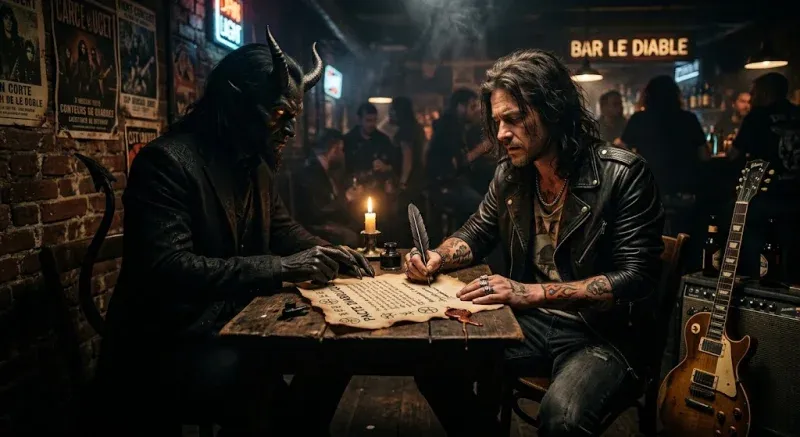
Here the popular tale takes a frankly diabolical turn. In the most widespread version, Amadio fled Italy for Spain after the war. There he met a small vagrant boy, an orphan whose family had supposedly died in a fire. A priest warned the painter: wherever the child went, fire followed. The boy's nickname, "Don Bonillo" or, more dramatically, Diablo, completed his reputation as a little demon.
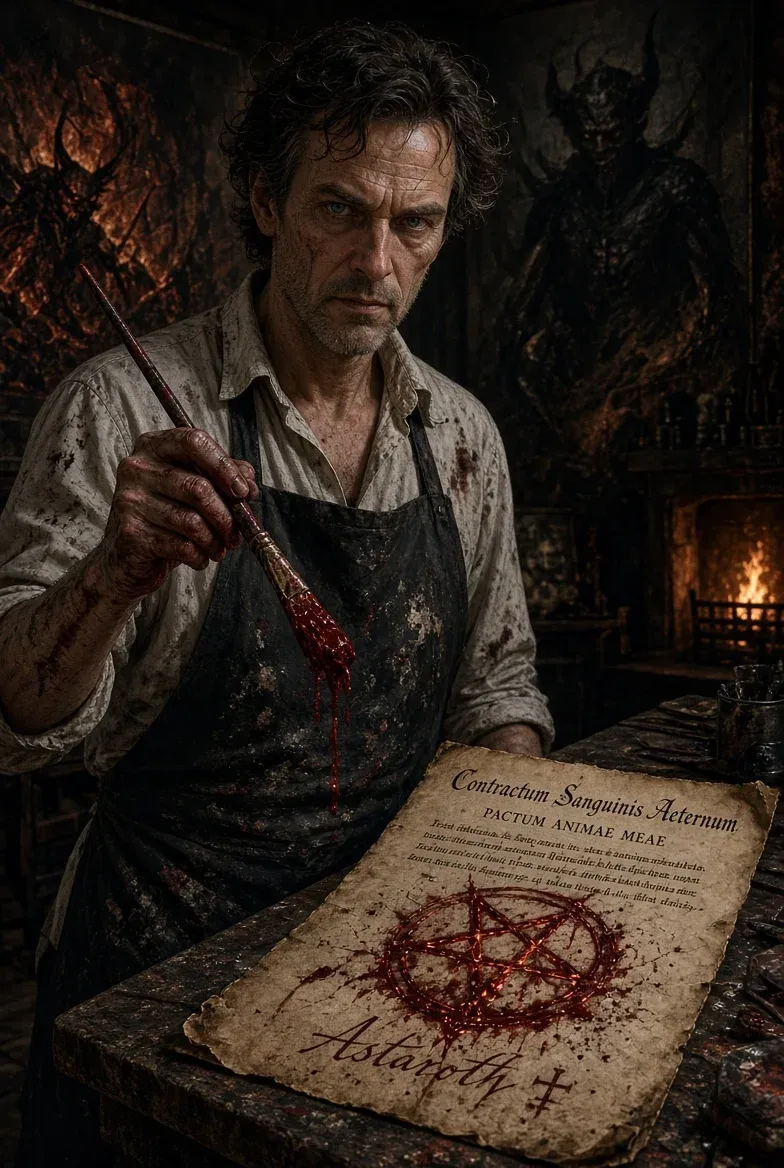
Amadio, out of pity or pride, ignored the warning, took the child in, and painted his series of portraits. Then his studio supposedly burst into flames. Convinced that the boy was responsible, the painter drove him away. In most versions the child then dies in a car accident or a fire, and his portraits, now steeped in his curse, begin spreading fire through homes. The painter himself is said to have perished in the flames.
That is the "pact": an artist who agrees to share his roof, and his glory, with a child the rumor calls damned.
1985: "Blazing Curse of the Crying Boy"
Yet the curse was not born in Spain, but in the columns of the British press. In early September 1985, a local newspaper in Rotherham, South Yorkshire, reported a house fire. Two days later, the national tabloid The Sun seized on the story. On September 4, on page 13, it ran an article titled "Blazing Curse of the Crying Boy": a couple, Ron and May Hall, blamed a painting of a weeping child for the destruction of their home, with the picture supposedly the only object to have survived the flames. Ron's brother, a Rotherham firefighter, allegedly added that similar cases were circulating at the fire station. (Some sources date the publication to September 5.)
The research of folklorist David Clarke shows that the affair was blown out of proportion by the newspaper. Its editor at the time, Kelvin MacKenzie, sensed a good story. Weeks of letters from terrified readers, accounts of fires, and new "victims" followed. The legend grew to the point that families who owned a copy no longer wanted to keep it in the house.
The Sun's Bonfire
Faced with the flood of letters, the paper offered to take readers' reproductions off their hands and destroy them. On Halloween night 1985, around 2,500 prints were burned on a bonfire in Oxfordshire. A firefighter present mocked the ceremony: they had expected stifled screams, but heard only the crackle of paper. The tabloid then declared the spell broken.
"I always say it's the tears that put the fire out." – the wife of firefighter Alan Wilkinson, quoted by David Clarke in Fortean Times.
What Rational Criticism Says
The case is rich in mundane explanations, which skeptical investigators lay out without difficulty. First, the argument from numbers. The Sun itself estimated that around 50,000 copies were in circulation in the United Kingdom. When an object decorates that many homes, it mechanically turns up in a share of domestic fires. The bias is pure statistics: comedian Ray Peacock, in an episode of The ParaPod, ironically sums it up by saying that any popular record, present in as many living rooms, would be "cursed" too.
Then there is selection bias. No one reports "a fire where the Crying Boy burned": only the cases where it survives make the story. Investigators also noted that the paintings were not identical: "a motley assortment," in David Clarke's words, of cheap prints sold in British department stores in the 1960s and 1970s. The only thing they shared was mass marketing.
To explain why the frames survived, commentators generally point to how these reproductions were hung and the backing they were mounted on, but this hypothesis, common in the skeptical literature, remains a plausible explanation rather than definitive proof. It was in any case not taken up by The Sun, which, as Clarke notes, had no interest in looking for a rational cause.
Finally, the genealogy of the myth. David Clarke points out that the story of the orphan "Diablo" does not appear until 2000, from the pen of Liverpool author Tom Slemen. This storyline, which explains who the child is and why the painter would have come to a bad end, therefore postdates the 1985 panic by fifteen years. As for Amadio, far from perishing in the flames, he died of illness in Padua: broadcaster and comedian Steve Punt traced his story for BBC Radio 4 (Punt PI, 2010), then published his conclusions in The Sun. The legend of a Spanish exile and a burned orphanage could not be confirmed. Italian skeptic Massimo Polidoro, in the Skeptical Inquirer (November-December 2012), likewise files the affair under urban legends.
Why the Myth Survives
The story of the diabolical pact endures because it ticks every box of the gothic tale: an artist on the margins, a cursed child, an ignored warning from the clergy, an innocent-looking object that spreads misfortune. It also works as a remnant of the folklore of "haunted objects," in which a painting becomes the vessel of a presence. The internet has only revived the rumor: forums, videos, and dealers' listings swearing they hold "the original cursed one."
The mystery, in the end, is how a myth gets manufactured. A portrait of a sad child, sold by the dozen to tourists in Venice, was enough to feed four decades of fear, with a well-oiled media cycle as its only "devil." Bruno Amadio never signed a pact. He painted, he sold, and without knowing it he left behind one of the finest case studies in crowd psychology.
 - Voir l'historique