
























| Localisation | Huánuco (Peru) |
With a 25-vote lead, Hitler Mussolini Simeón Flores, 45, won the municipal election in Queropalca, tucked away in the department of Huánuco. Cosmic coincidence, a prank of fate, or simply a naming fashion? We look into one of the most baffling electoral stories of the year.
On Sunday, October 4, 2026, Peru went to the polls to renew its regional and municipal authorities, a few months after Keiko Fujimori's victory in the presidential election. Among thousands of lists competing across the country, one ended up crossing borders: that of the district of Queropalca, in the province of Lauricocha, north of Lima.
In this district of barely more than 730 inhabitants, the contest was close. According to the provisional count relayed by several Latin American media outlets, the candidate of Ahora Nación, a center-left party, gathered 229 votes, or 34.54% of valid votes. He finished 25 ballots ahead of Renovación Popular Perú (204 votes), while Partido País para Todos came third with 187. Alianza para el Progreso (35 votes) and Somos Perú (8 votes) brought up the rear, for a total of 663 valid votes.
While Euronews and several other outlets speak of an "elected" mayor, others, including El Imparcial and NTN24, are more cautious and refer to a "virtual winner" based on the provisional count. Official proclamation by the electoral authorities remains the step that will seal the result.
Who Is Hitler Mussolini Simeón Flores?
According to information circulated during the campaign, he is a native of Queropalca. He also runs Simeon SAC, an investment group based in Pillco Marca, also in the department of Huánuco. His biographical profile, so far, contains nothing pointing to any sympathy for the regimes whose leaders his first names recall: he ran under the banner of a party that describes itself as center-left, and whose platform rests on the idea of Peru as a "nation in formation."
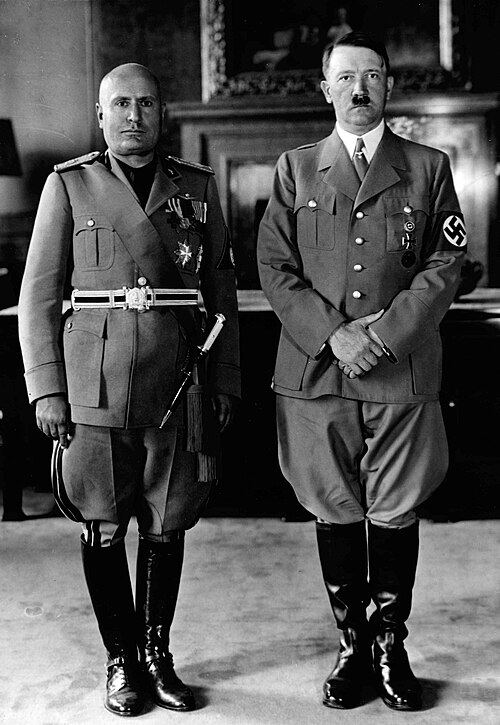
It is therefore only the candidate's civil name that triggered international interest: the pairing, on a single line, of the master of the Third Reich and the founder of Italian fascism, two Axis allies during the Second World War.
"Hitler sí, corruptos no" ("Hitler yes, corrupt politicians no")
Slogan chanted in the streets of Yúngar in 2018, during the victory of another Peruvian mayor named Hitler.
The Yúngar Precedent: The Andes' "Good Hitler"
The Queropalca case is not a first. In October 2018, another Peruvian, Hitler Guesclin Alba Sánchez, was re-elected mayor of Yúngar, an Andean town in the province of Carhuaz, in the Áncash region, perched at more than 2,800 meters above sea level. A graduate in statistics and computer science and the son of farmers, he had already held the post from 2011 to 2014.
His campaign made headlines around the world with slogans worthy of an alternate-history novel, "Hitler returns" and "Hitler with the people." The man himself readily described himself as "the good Hitler," insisting that he rejected everything the German dictator stood for. He won 47.7% of the vote. The episode took on a farcical tone when a resident of a neighboring district, Lenin Vladimir Rodríguez Valverde, tried to have his candidacy invalidated, without success: the electoral authorities rejected the request.
The same onomastic universe also reached the legislature: according to Diario Panorama, a surgeon named Hitler Saavedra Casternoque held a seat in Congress for Somos Perú from 2021 until his death in 2024.
Why Emperors' and Tyrants' Names in the Andes?
The answer has less to do with the paranormal than with the sociology of first names. Hitler Alba himself explained to Peruvian radio station RPP that in the 1980s, giving a child a foreign name was a novelty, and that his father was unaware of the connotation of the name he had chosen. He had even considered changing it before giving up out of respect for his father's wishes, according to the Reuters dispatch.
The phenomenon goes beyond the name Hitler. Reuters noted in 2018 that parents in Latin America regularly choose exotic names despite their negative associations abroad, and cited a certain Osama Vinladen called up to a Peruvian junior national football team the previous year. In Yúngar, the rivalry with a "Lenin" extended this curious tradition that leads Andean families to draw on the pantheon, glorious or sinister, of world history.
Nomen Est Omen? When Names Seem to Write Destinies
This is where the story brushes against the fringes of our beat. Since antiquity, people have believed that a name carries a destiny, from the Latin adage nomen est omen to magical traditions in which naming is summoning. In the 1990s, the "Feedback" column of the science weekly New Scientist popularized the term "nominative determinism" for those amusing cases of people whose profession resembles their surname.
The Swiss psychiatrist Carl Gustav Jung, together with the physicist Wolfgang Pauli, proposed in 1952 the concept of "synchronicity," a meaningful coincidence between events with no apparent causal link. A mayor named Hitler Mussolini in an Andean district, after another mayor named Hitler a few hundred kilometers away: here is ample material for the boldest Jungian readings.
The Critical Analysis: Coincidence, Bias, and the Law of Large Numbers
The skeptic will temper the enthusiasm of sign-seekers. Statisticians Persi Diaconis and Frederick Mosteller formalized in 1989 the "law of truly large numbers": in a large enough population, improbable events cease to be exceptional. With thousands of municipal candidacies and a widespread use of history-inspired names, the probability that one of them carries a controversial historical name approaches certainty.
As for "nominative determinism" itself, its scientific foundations are disputed. The "implicit egotism" hypothesis advanced by Brett Pelham and colleagues in 2002, according to which we would be drawn to choices resembling our own name, was challenged by Uri Simonsohn in 2011, who identified confounding factors that could explain part of the results. Nothing demonstrates that a first name steers a political career, let alone a vote.
Nothing in the published material indicates, moreover, that the name weighed at the ballot box: in Yúngar, voters explained that they had no "complex" about their mayor's name, whom they judged on his record. The story's virality owes much to a media framing bias: in the global news flow, the mention of a name loaded with history attracts clicks, whatever the real significance of the event. Finally, a name is not a platform: a father's choice, sometimes made in ignorance of the name's historical weight, says nothing about the adult's convictions.
What Happens Next?
The official proclamation of results and the swearing-in should, in principle, take place over the coming weeks and months, following the calendar of 2018, when the mayor of Yúngar took up his mandate in January. Until then, Queropalca, its roughly 730 residents, and their future mayor will have to cope with a notoriety nobody had planned for. The Strange Courier will follow the case as it develops.
 - Voir l'historique